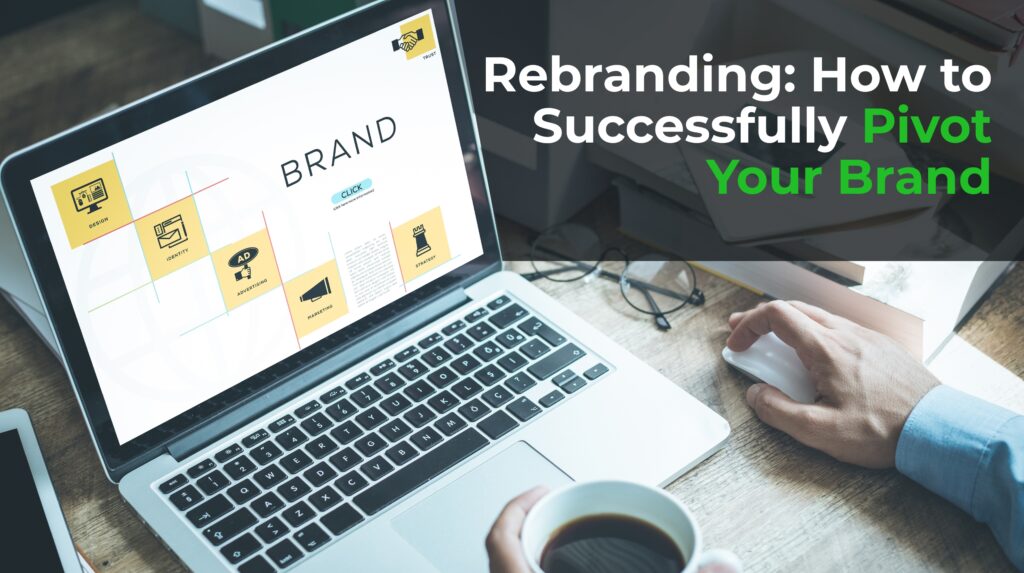
Rebranding is one of the most consequential decisions an Irish business can make. Done with strategic rigour, deep audience understanding, and creative precision, a rebrand repositions a business for a new era of growth. Done poorly, it alienates the existing customers who built the business, creates market confusion that takes years to resolve, and delivers no measurable commercial benefit despite significant investment.
The difference is almost never a question of design quality alone. It is almost always a question of strategic preparation, audience intelligence, and disciplined execution. Dublin Branding Agency has guided Irish businesses through brand pivots at every scale and the lessons from those engagements are built into every step of this guide.
What Is Rebranding Ireland and When Does It Make Strategic Sense?
Rebranding is the process of changing the identity, positioning, messaging, or visual presentation of a business to better reflect its current reality and future direction. It is not a logo refresh. True rebranding is a strategic repositioning of how a business presents itself to the world.
Rebranding makes strategic sense in specific circumstances:
- You have substantially expanded your services beyond what your original brand communicated
- You are entering new geographic markets and need a brand identity that performs at that scale
- A merger or acquisition has created conflicting brand identities that need resolution
- Your business is recovering from reputational damage and needs to signal a genuine new chapter
- Your brand has become visually or strategically dated and is actively working against credibility
- Your target audience has fundamentally changed and your current brand no longer speaks to them
The right question before any rebrand is not what should our new brand look like? It is why does our current brand no longer serve our commercial objectives, and what specifically must change to correct that?
The Risks That Destroy Rebranding Exercises
The patterns of rebranding failure are consistent and predictable across Irish and international markets:
- Moving to design before research commissioning creative work before understanding what the audience values
- Changing what customers love disrupting brand elements that existing clients associate with quality
- Inadequate launch communication leaving existing customers to discover the rebrand without explanation
- Fragmented rollout some channels updated, others still carrying the old brand
- No defined success metrics no framework to evaluate whether the rebrand is working
The most dangerous rebrand is one that changes the elements of a brand existing customers value without replacing them with something equally compelling. This is why research and strategy are the work the design is their expression.
Step One: Define the Strategic Rationale With Precision
Before any creative thinking or agency brief, the strategic rationale for the rebrand must be documented and agreed at a senior level. This document becomes the brief that governs every subsequent decision.
It must provide clear, evidence-based answers to:
- Why is the current brand failing to serve the business commercially?
- What specific problems is it creating or contributing to?
- What must the new brand achieve that the current brand cannot?
- Who is the target audience for the rebranded business, and how does this differ from now?
- What must remain constant through the rebrand to preserve existing client relationships?
- What must change to achieve the strategic objective?
Step Two: Research Your Audience Before You Redesign
Audience research is the step that separates rebrands that strengthen a business from those that damage it. It must encompass three distinct audiences:
- Existing customers what do they value about the current brand? What would they be unwilling to see changed?
- Target new audience what would need to be true of your brand for them to see you as credible?
- Competitive landscape what brand territories do competitors occupy that you must differentiate from?
For Irish businesses with established client bases, existing customer research is commercially critical. These are the relationships generating current revenue, and protecting them through the transition is essential.
Step Three: Build the Brand Strategy
Brand strategy is the articulation of who you are, who you serve, what you stand for, and how you are distinctively different from every alternative. It defines:
- Your brand positioning the specific territory your brand occupies in your market
- Your brand personality the human characteristics that describe how your brand behaves
- Your tone of voice how you communicate across every channel and format
- Your messaging hierarchy what you lead with, what supports it, what you never lead with
- Your brand values the principles that govern every brand decision going forward
At Dublin Branding Agency, brand strategy development always precedes any creative brief. Design is the expression of strategy, not a substitute for it.
Step Four: Develop the New Visual Identity
With a fully developed brand strategy as the foundation, visual identity development can begin. This encompasses:
- Logo design primary mark, secondary marks, and usage rules
- Colour palette primary, secondary, and neutral colours with psychological rationale
- Typography system primary and secondary typefaces with hierarchy rules
- Imagery direction photography style, illustration approach, and visual language
- Design principles governing how all elements combine across every application
Every design decision must be justified by reference to the brand strategy. Quality testing across all relevant applications digital, print, signage, social media before finalisation is essential.
Step Five: Plan and Execute the Launch
The launch of a rebrand is as much a communication challenge as a design challenge. Existing customers must be informed before the rebrand goes live not after.
Effective rebrand launch communication includes:
- Advance client notification explaining what is changing and, crucially, what is not
- Clear framing as natural evolution, not rupture driven by growth, not dissatisfaction
- Simultaneous rollout across all channels: website, social media, Google Business Profile, email
- Team briefing so every person in the business can communicate the rebrand confidently
- Press and PR if the rebrand is significant enough to warrant external coverage
Step Six: Manage the Transition and Track Outcomes
Even a perfectly executed rebrand requires careful transition management. Old brand assets surface in unexpected places. Create a comprehensive audit of every place your brand appears and work systematically through the list.
Define the metrics that will tell you whether the rebrand is achieving its strategic objectives:
- Branded search volume trends is more people searching for your name by name?
- Direct website traffic are more people navigating directly to your site?
- Inbound enquiry quality are you attracting better-fit clients?
- Customer retention rates are existing clients staying through the transition?
- Average contract or project value is the rebrand improving commercial positioning?
Frequently Asked Questions
How do I know if my Irish business needs a rebrand?
Your business likely needs a rebrand if your current brand no longer accurately represents your service offering, if you are struggling to attract a new target audience, if you are entering new markets where your brand does not project the required credibility, if a merger or acquisition has created conflicting identities, or if your brand has become visually dated enough to create credibility concerns with potential clients.
How long does a professional rebranding process take for an Irish business?
A professionally managed, strategically thorough rebranding process for an Irish SME typically takes between three and six months from strategic brief to public launch. This encompasses audience research, brand strategy development, creative development, refinement, and launch communication planning. Rebrands completed in less time invariably cut into research and strategy the phases most likely to prevent costly errors.
Will rebranding damage my existing SEO rankings?
A rebrand involving a domain name change requires comprehensive SEO planning, including a complete redirect strategy, to protect existing organic rankings. A rebrand retaining the same domain but updating visual identity and messaging has minimal direct SEO impact when managed correctly. A stronger, more coherent brand identity tends to improve user engagement signals over time, contributing positively to rankings.
Can I rebrand without losing existing customers?
Yes, with the right communication strategy. Informing existing customers in advance, explaining the rationale clearly, and providing specific reassurance that your core values, quality, and service standards are unchanged are the keys to retaining loyalty through the transition. Customers are generally supportive of brand evolution communicated with honesty and that reflects genuine growth.
How much does a professional rebrand cost for an Irish business?
The appropriate framework for evaluating the cost of a rebrand is not the absolute number but the commercial return it delivers higher credibility, stronger positioning, improved conversion rates, and the ability to attract better clients at better margins. Dublin Branding Agency provides rebranding engagements scaled to the complexity and commercial ambition of each client.
Ready to grow your brand? Dublin Branding Agency helps Irish businesses build powerful brands, rank on Google, and convert visitors into loyal customers. Visit dublinbranding.ie today to start the conversation.